Posts tagged with improv

Kinesthetics Responses & Forces and Forms

Last night I attended a "Developing Characters in Improv: Bringing Characters to Life on Stage” class from Queen City Improv’s Rick Reebenacker. I enjoyed this class so much. As a former animator and now improvisor I see a lot of overlap in the two fields. I mean, they are both acting. 

Rick led us through some exercises about Kinesthetics Responses - sensing and responding based on how you feel, and the stored and expressed energy. I’ve been mindful of the body language, emotions, and space work (where on stage people are and where they are moving from/to) of my scene partners for a long while now. But I never thought of it in the terms Rick used. Something clicked for me and another level was unlocked in my studies. 

It’s similar to when I was a working animator and our team was exposed to a concept I believe attribute to Disney animator Don Graham. Animate forces, not forms. Instead of moving the forms of the character through space, you focus on the forces behind the movement. Inertia, gravity, momentum, weight, mass, etc. These concepts are in balance and in conflict when something moves.

Think of it this way: walking is controlled falling.

In my mind there’s something connecting these concepts and I can’t wait to explore it more in part two of the class.

Playing with Complexity

I’ve been thinking, creating, and piloting workshops that combine some elements of Complexity Science and Improvisation. You could call this Applied Improv, where facilitators take the mindset and tactics of Improv and help leaders, teams, and organizations communicate, collaborate, and explore creativity. 

But by weaving in the aspects of Complexity Science, especially emergence, we can dig deeper and explore how feeling complexity in one's body helps understand the complexity around your work. 

I’ve soft launched this service, and wanted to post here as well. More to come.

https://playingwithcomplexity.com

Noodle and Prance

We had our first meeting/practice of the new improv group yesterday. We’re currently calling ourselves Noodle and Prance. One of our members volunteered the name as it’s the name of their cats. We all thought that was funny, so here we are. 

Over the last couple years, I’ve been taking classes, going to jams, and auditioning for the existing improv groups in the area. Portsmouth and the surrounding areas in New Hampshire, Massachusetts, and Maine have a really good and rather large improv community. Both the Stranger than Fiction and Queen City Improv groups have done a lot to foster the community. As well as the local improv incubators in Portsmouth and Portland. Shout out to all those folks. 

In Noodle and Prance, we're being coached by Harry, who’s got something like 30 years of performing improv and acting experience. He’s a good fit for where we want to go and his general mindset on Improv. We’re really lucky to have him. 

I’m really looking forward to getting to know the other folks in the group better, practicing, and eventually performing. We’re looking to perform long form. Not "Who’s Line is it Anyway” - that’s short form. Wonderful, funny, absurd in the best way possible, imho. But Long form improv is about getting a suggestion or hearing a short story from the audience, or a guest speaker and then the improvisers make up scenes based on these suggestions. These performances are more like mini-plays. They can run anywhere from 20 minutes to an hour. 

Check out "Middleditch and Schwartz” on Netflix if you have it. Or go see a live "Ben Schwartz and Friends” show if they come to your town and you can get out to the show. For me, those two things are the high water mark. Improv isn’t really a competition (or shouldn’t be) but I consider Schwartz to be my favorite improvisor. So good. 

Anyway, we haven’t discussed when we think we’ll be ready for some shows, but I am hoping within a couple months. Like I said there’s a strong community here, so I’d love to do a show with a couple of different groups. I feel like Improv is having a moment, as they say. People want to come together. To experience things together again.

If you can get to a local improv show, I think you should give it a go. But I’m (obviously) biased 😄
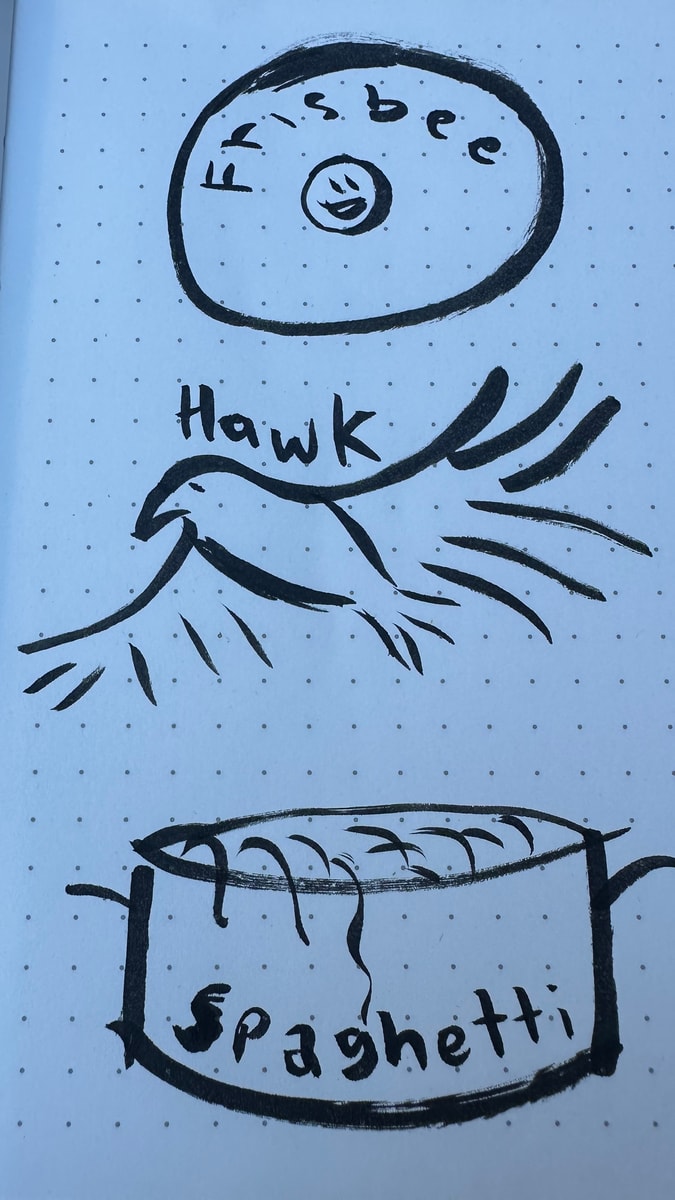
A frisbee, a hawk, some spaghetti, and information overload.

Uploaded image

Knife, Hawk, Spaghetti is an improv game usually used for warming up the performers in practice or before a show. You would likely never see this game during an actual improv show, as it’s a game to get performers minds and bodies warmed up, and doesn’t play well on a stage. 

It’s one of my favorites as it forces you to lock in on the present moment, and play with complexity. It goes like this:

Everyone stands in a circle.

  • One person makes eye contact with someone across the circle, and pantomimes throwing a knife at them, yelling “Die!” as they throw the knife. The other person catches the knife mid-air and yells “not today!”.

You run that through the group until everyone has had the chance to throw and catch the knife. Pause the knife, then introduce the hawk. 

  • One person starts by pantomiming a hawk on their forearm. They make eye contact with another person, and yell “hawk”! The other person makes the same pantomime pose, and yells “come hawk”! The first person launches the hawk and the second person catches it. 

Give everyone a chance to throw and catch the hawk. Then pause and introduce spaghetti. 

  • One person starts by pantomiming holding a big pot of spaghetti and mixing it with a big spoon. They walk across the circle and offer the spaghetti to someone else and ask “do you want some spaghetti”, the other person replies “not today” but takes the spaghetti anyway. The second person walks across the circle to repeat the bit, while the first person takes the seconds place. Repeat until everyone has had a chance to give and take the spaghetti. 

Now you repeat the knife. As the knife is traveling around, you bring in the hawk. As those are traveling around, you bring in the spaghetti. 

Chaos and pandemonium. I love it. 

There are three distinct channels of communication, and the people in the circle are not staying in the same spots. This is an exercise that is built to fail by design. 

I love bringing this warm up into workshops for teams and business too. I typically replace knife with a frisbee to focus on non-violent communication. It works just as well as the knife and it keeps the space safe. 

There’s too much happening at one time to have the game sustain for a lengthy period of time. Plus people laugh a lot. It helps bring down some peoples self-imposed barriers, and be a little vulnerable with each other. 

Seeing people experience being uncomfortable in a safe space is one of the great things about these workshops (if I do say so myself).

When I ask participants how did that feel or what did you experience, the theme of the answers is I felt information overload or how multitasking is harmful.

One participant said:

Multi-tasking causes confusion and contributes to “dropping the ball”.

I then ask them to consider all the inboxes they have at work. Email, Microsoft Teams or Slack (or both!), internal web pages/blogs, mountains of wiki pages, the sneaker-net (people popping by your desk to chat/water cooler conversations). 

Then I ask how did the frisbee, hawk, and spaghetti experience inform you on how you can manage the information overload? 

Answers typically are:

  • You can’t manage it.
  • Scan the horizon, don’t dig too deep on them all.
  • Some teams decide to divide up to focus on one ‘channel’ for a week or sprint, then rotate.

You can’t manage information overload, but playing with it leads to some great insights and actions. 

The Monoscene

I’m about to wrap up a level 301 Improv class with Stranger than Fiction. Our class culminates in a student showcase. Our class opens the show for the main cast. There’s 11 of us in class and we’re performing the Monoscene format. Come see us in Portsmouth on Friday August 15th, 2025!

The Monoscene is just as it sounds. One scene. Everything takes place in one location. It’s a challenge as each performer has to manage their own entrances and exits. Other formats handle that in different ways, usually by an off-stage performer choosing when to “edit" the scene. Ending one scene and beginning another. 

With the monoscene the location is usually a suggestion from the audience. "Can I please get a non-geographic place that will fit on the stage?” 

A book store, or comic book shop, or train station ticketing and waiting area. That kind of thing. 

Typically the performers play the same characters throughout. Two person scenes are typically performed. So everyone has to justify entering and exiting. Or fading into the background to clean the table in the back or whatever. 

It’s a fun challenge and I’ve really taken to like the format. 

Like most things in Improv it scared me at first, and now I really enjoy it. 

Applied Improv for Pixels and Polygons

I left the field of game development and animation about eight years ago. A lot has happened in those eight years, to me and that industry. I still am connected to friends in those areas. I’ve been thinking of volunteering to help folks who are working in animation, or are trying to break in. I can’t really comfortably teach animation any longer, as it’s been so long. You know, nothing has really changed, but everything is different. That kind of thing.

Anyway, I've been thinking of what related or relatable things can I do as a volunteer? I’ve been studying and performing improv for a long while. A couple years ago I started using the mindset, tactics, and games of improv at my day job as a facilitator. This is generally referred to as Applied Improv. As in applying Improv to the workplace or classroom.

I know that animation is acting and Improv is acting. So I thought there would be a nice fit here. I reached out to Anthony Marquette who runs Pixels and Polygons: School of Digital Art & Animation. He and I go way back, and it was good to see the great work he’s doing at his school.

We had a couple meetings, and set a plan in place for me to run an Applied Improv workshop for the students. We wanted to focus on communication, collaboration, and creativity. Improv is a perfect way to explore and strengthen those things.

Also, there are clear psychological benefits to Improv comedy as made evident by this article:

  • Brain-scan studies have shown that improv activates creative brain centers and can help with brain connectivity
  • Psychological studies have shown that improv generally boosts creativity and confidence
  • Studies also show that improv generally decreases stress, anxiety, and uncertainty intolerance (being more OK with the unknown)

You can’t do one Improv workshop and be a master of those things, of course. But participating in an Improv workshop is a small nudge in those directions. And embodied and immersive participation literally opens new pathways in your mind. 

Which is rad.

We set an Agenda

I communicated to all participants that the Agenda below is subject to change based on what emerges in the workshop. Since you can't control the unscripted.

  1. Introductions and what to expect [10 minutes]
  2. Warmups [20 minutes]
    1. We started with games that were designed to 'shake off the day' and prepare us for the rest of the workshop. We then built to games to establish silliness, and break down some self consciousness. We concluded with some games to help with rapid idea generation. To work from abundance.
  3. A selection of communication and creativity based improv games [30 minutes]
    1. I chose a selection of storytelling games. Each with different and all with escalating constraints. Constraints help build creativity. These games also introduce deep listening, one of the hallmarks of good communication.
  4. Break [15 minutes]
  5. A selection of storytelling based improv games [30 minutes]
    1. We continued with storytelling based games and escalated to multi-layer storytelling games. These are games where all participants play but in different, interconnected ways. 
  6. A selection of scene based improv games [45 minutes]
    1. We dove deep into scene-based games and kept character top of mind. I was surprised that the participants were so engaged in the classic "three line scene" game. Usually people have to warm up to that one. All participants jumped into that straight away, and we kept playing that game longer than I anticipated. Goes to show that you never know what will emerge
  7. Backline games [15 minutes]
    1. We started closing down the workshop with backline games. This is where all player are in a line towards the back of the performance space or stage. Ahead of time you take some one word suggestions. Then you provide a prompt. Like "worlds worst ... " and you fill in the blank with on of the one word suggestions. World's worst plumber as an example. Then folks from the backline step up, one at a time and act like the world's worst plumber. Since this was a group of aspiring animators, we had a lot of fun with "animating with me is like ...".
  8. Q/A and Closeout [15 minutes]
    1. I took a couple questions, shared some tips and resources, and we all said our goodbyes.

Feedback

Anthony was kind enough to ask the participants for some feedback and he shared it with me. One participant asked:

When can we do it again?


That's the best kind of feedback I could have hoped for. This kind of workshop is arguably not directly tied to outcomes. It's tied to communication and (not to get too woo-woo) it's tied to being. Presence. Being human. Making mistakes, and taking them as an offer to build on.

Emergence and Complexity

On the stage, improvisors do not know what is going to happen next. They have to listen to their partners. Really listen to them, then add something to heighten the stakes. That's the "Yes, and". Whatever they do on stage, together, can't be recreated exactly later.

The performance is unique and can only be influenced, not controlled. Things emerge. Performers can "Yes, and" in ways to influence. Trying to control it makes it fall apart.

I'm just beginning to associate improv to complex systems, but I'm already seeing a lot of overlap. I'm speaking to some people who feel the same way. I'll keep thinking and writing about it.

Humans, and human systems are complex. Telling stories is how we share what we did in the midst of all the complexity.

File this under "I have no idea if this will work" but I was wondering if I could host a conversation or two with a professional improviser and a complexity scientist. I wonder what would emerge in those conversations. Maybe I'll try it.

Want to do some Improv together?

If this was interesting to you and you'd like to talk about how I can do this for your team, email me and let me know. I'd love to talk about it some more. 

Complexity, Walking, and Improv

I’m new to the study of Complexity Science. I’ve heard Complexity Science defined as the study of networks of adaptive agents. Ant colonies, people, organizations, and economic markets are all examples of complex systems.

Also, I like these definitions of the features of complex systems from Karoline Wiesner on the Podcast Simplifying Complexity: The 10 features of complex systems: Part 1 and 2.

https://podcasts.apple.com/us/podcast/simplifying-complexity/id1651582236?i=1000613078804&r=21

10 features of complex systems 

  1. Numerosity: The presence of many interacting components or agents within a system.
  2. Disorder and Diversity: The random behavior and variety among the components of a system, which allows for exploration and interaction.
  3. Feedback: The process where the output of a system influences its own functioning, leading to adjustments and changes.
  4. Non-Equilibrium: A state where a system is continuously changing rather than remaining static, often driven by external inputs or interactions.
  5. Emergence: The phenomenon where larger entities or patterns arise from the interactions of smaller or simpler entities that do not exhibit those properties.
  6. Spontaneous Order and Self-Organization: The process by which order and organization arise from the local interactions of components without central control.
  7. Non-Linearity: Relationships within the system where outputs are not proportional to inputs, often resulting in tipping points or rapid changes.
  8. Robustness: The ability of a system to remain functional despite perturbations or damage.
  9. Nested Structure and Modularity: A hierarchical organization where systems consist of smaller subsystems, each serving distinct functions. Nested Strucure is hierarchical, and Modularity is functional
  10. History and Memory: The capacity of a system to retain information from past states and use it to influence current behavior.

I recently played a couple “walking” Improv games that I thought really embodied a lot of the principles of complexity science indicated above. 

  • We all started by meandering about the space (creating the network of adaptive agents/ numerosity). 
  • Then we got direction to smile and say “yes” to people in proximity and think how that made us feel (feedbackfrom agents). 
  • Then we were told to make a distinctive walk (Diversity/disorder). Then to “double down” on that unique walk. 
  • Then to observe others walks and incorporate one element of someone else’s walk in our own (Non-equilibrium, Emergence). 
  • Lastly to all adapt to the same walk (Robustness). 

I’m new to complexity science, so maybe I’m seeing and feeling what I want to see lol. But to me there’s a connections with improvisation and complexity, especially around emergence as a core concept in both.

Everything is Unscripted

Will tomorrow look and feel a lot like today? Probably, yes. Will five years from now look and feel a lot like today? Plausibly, maybe. Possibly, no one knows.

No one can see the future. Hell, no one knows exactly what to do right now. We strategize and plan and then the unexpected happens (it always does) right before we need to do that thing we spent all that time planning.

We’re taught to plan the work and work the plan. And arguably that’s important, but it can’t be urgent. It can’t be responsive and everything is unscripted anyway. 

You know who has all this “embracing uncertainty” stuff figured out? 5 year old kids. They make up the rules of the game while they’re playing the game. 

Play is such a powerful way to learn. To “learn the rules” sure, but also how to get along with people. How to communicate, collaborate, and create with one another.

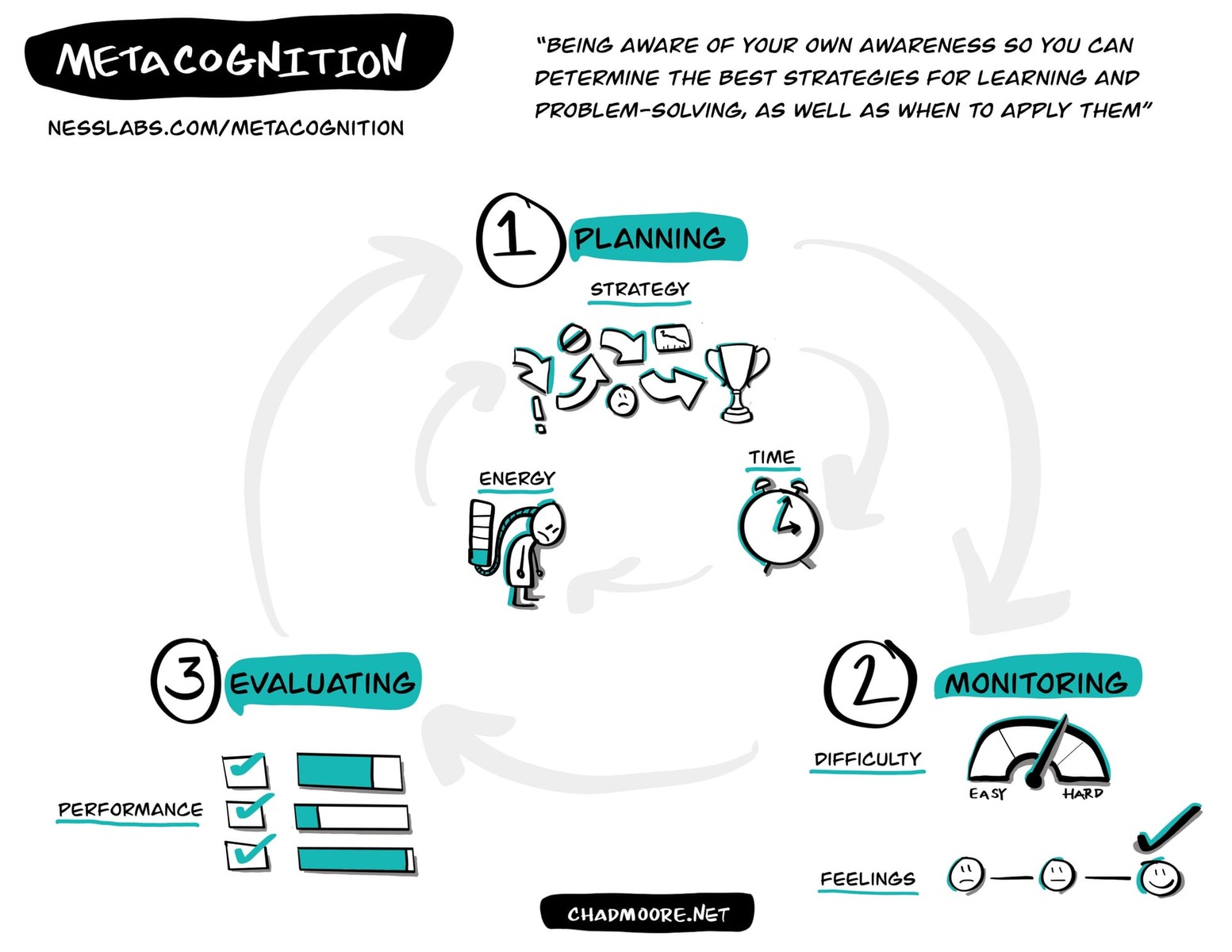
The systems were all a part of discourage play and encourage more serious ways of learning. Learning how to learn is important, and knowing which mindsets and tactics are best for the specific goal is great.

Uploaded image

metacognition

However, we’ve lost play as a learning component along the way. We’ve lost a valuable tool in our help-me-make-sense-of-all-this toolbox.

You know who else has that “embracing uncertainty” thing figured out? Improvisers. 

If you want to bring play back into your life (which has psychological benefits) reach out to an improv person or troupe near you.