I was wandering along the beach this morning, as the tide was coming in. To avoid the waves, I dodged, skipped over a rock pile, and scooted playfully. I don’t mind getting my sneakers muddy or wet. For a couple seconds, I played a fun game with the waves. I smiled and continued up the beach like a normal adult.
I then eyed a person nearing me from the other way. I didn’t notice them at first as they were behind the rock pile. They chuckled at my play. Instead of being embarrassed I just smiled. They did too. We traveled our separate ways without any words being shared. Turning away, I caught a playful spring in their step.
I spoke with a friend who described this truly interesting thing he's doing for his work. It involves AI. After he finished describing it and the real value it's creating he wondered out loud... How many buffalo did I just kill?
Another friend I spoke to recently said a similar thing. He feels he needs to use AI or he'll be out of a job. There's a lot of pressure from the major players in the field he works in to use AI for cost cutting. Not so much for innovation, but that may come with constraints. He hopes.
He says he loves the innovation possibilities, and hates everything else about AI.
I know a little bit about the field of complexity science. The thinking here is chaos theory (in a nutshell). We can't control the results of our actions. It's non-linear and positive and negative things emerge. Or things emerge and we label them as positive or negative.
Use AI to do a thing
That uses so much water to cool the data center that a buffalo can't find water
the buffalo dies
scavengers feed on the remains
etc
This is my very rudimentary understanding of the butterfly effect. The whole "A bird flaps its wings in NYC that causes a tornado in Japan" thing.
How many steps ahead can you see when you play chess?
Are you directly responsible for the buffalo dying? Or the scavenger getting to live another day?
Why can you control?
Influence?
Be concerned about?
You're driving. Fifteen minutes ago someone "let someone in" disrupting the flow of traffic, and now you're in an accident.
Everything is connected.
My Buddhist friends would say:
We're all part of an interconnected web of life
Our actions have ripple effects on others and the world
This understanding is supported by wisdom and results in compassionate action
We need to connect more deeply with life at all levels
Paradoxes in paradoxes. I'm tired of trying to make sense of it all. Just be nice to people, do what you think is right as long as it doesn't knowingly harm another. Apologize when you fuck up.
Yesterday I ran a retrospective workshop for a group of folks at work. We used the constellations activity, which is a really interesting format. In my experience it helps people think hard about “group think” and “group mind”. The former generally being not very effective, the latter being amazing when channeled properly at the work place.
To me, Group Think closes doors. It slows innovation and creativity, and ultimately progress, however you measure it. Group Mind on the other hand makes people feel like they have each other's backs, are moving in the same direction, and open to new ideas to find the next best thing.
You can run Constellations digitally by having participants move a sticky around a mural or miro board. But there’s nothing better than doing this in person.
You get the body language. You get the social pressure (that helps you think about group think and group mind), people are more open to smiling and laughing when together. Teams and Organizations can’t only laugh their way to achieving their OKR’s, but laughing sure does help teams come together and get that group mind.
Laughter is the second best medicine after all.
I haven’t received participant feedback yet (other than some comments during and directly after the event). I would have liked 20-30 more minutes to get to some ideas/hypothesis/experiments for people to commit to. But that exercise was to be covered at a later time in the agenda, after the constellations event.
If you need to do a retro in person, I highly recommend this exercise. It’s really powerful.
June is typically a busy month for me and my family. Birthdays, Anniversary, the end of the school year. Spring is making its way into summer. Yard work. Broken lawn mowers.
Turns out, it's a lot.
This year is even busier than usual with a too-short trip for me to Long Island to see my parents. Another trip to Montreal to visit a college. Graduations for close friends. A missed opportunity to travel to Spain for something wonderful.
And work is more challenging than ever. I just had my six year anniversary at work. I thought I would be at this company for three years, tops. Funny how things happen.
Turns out, everything is a lot.
I haven't even mentioned my repulsion and fear at what is happening in the US. And concern for the events overseas too.
Turns out, everything is too much.
At the end of May, Hey Party People! put on two shows, on back to back nights. They went great, and I loved writing and acting in the sketches. We had a lot of new-to-the-troupe actors. Mostly younger folks than I, who knew each other from other creative outlets. It was wonderful to get to know them and see them jump right into the unknown. Fearless. Funny. Fantastic.
I typically turn to creativity to help put a little something good into the world. A laugh or two via comedy, a little piece of art via sketchnotes or zines.
But that show schedule included a lot of driving, and a lot of creative energy. Plus logistic management.
Turns out, I'm burnt out.
So I am seeking some intentional solitude. A couple hours away from it all. Don't let the term intentional make you think goals. 'Make pen marks in a notebook' is the only goal if there is one. Intentional in terms of I intend to let my mind wander.
Our calendars are full, we're overcommitted. We do too much. We think rest is lazy. But letting your mind bounce around aimlessly through the woods is the way we find new paths through the woods. That's how we find new woods to bounce around in.
So on Saturday June 14th, and Juneteenth (Thursday June 19th) I have some time set aside to be alone and let my mind wander.
I'll report back once I find my way back through the woods.
Despite growing up on Long Island, New York I don't know much about sailing. But I wholeheartedly believe that a rising tide lifts all ships, as long as everyone has sea-worthy boats.
Three of my major influences:
One:
This is the longest running research ever conducted. I find it fascinating in scope and outcome.
The clearest message that we get from this 75-year study is this: Good relationships keep us happier and healthier. Period.
Two:
The Five Regrets of the Dying is a lighthouse for a life well lived in my humble opinion:
I wish 'd had the courage to live a life true to myself, not the life others expected of me.
I wish hadn't worked so hard.
I wish I'd had the courage to express my feelings.
I wish I had stayed in touch with my friends.
I wish that I had let myself be happier.
Three:
We cannot live in this world alone. We can't even come into this world without the help of two other people.
Virginia Satir, Your Many Faces
As such, I am working on my relationships. To myself and my family and friends. To my Communities. I’m ultimately trying hard to understand what’s in my circle of control, influence, and concern so that I can be present and help create equity in some way shape or form.
The wheel. Fire. The Internet. These are often cited as humanity’s greatest inventions. I think we’re undervaluing paper. If someone asked me what the greatest inventions we’ve made are, I’d add paper to the list. And add a caveat to the Internet. The un-enshitified Internet, but that’s another post all together :)
I listened to this episode of The Art of Manliness podcast, and immediately had a fun idea.
Roland Allen the guest and author of the book The Notebook, A History of Thinking on Paper mentions several different kinds of notebooks people have kept over the centuries.
The Commonplace Bookis a notebook format in which people add quotes and ideas and other interesting things they come across and categorize and organize them with a rigorous approach. The goal is to look through them and find things that can spark your own creativity.
Some people do this on index cards. Search for author Ryan Holiday’s Commonplace, and you’ll find a wealth of info on how this writer uses these techniques.
Friend, I’ve started and abandoned no less than three commonplace books. There’s too much structure for my personality type and I’m a Forager not a Librarian.
The Zibaldone notebook format is more similar to what we in the US would call a diary. You add your notes, ideas, maybe things you’re seeing and reading, doodles, cutouts from other paper based things, whatever. Most folks kept these as recordings of their days.
This article refers to a Zibaldone as the 13th century answer to tumblr. Gather round kids and let crazy uncle Chad tell you about a blog platform called Tumblr we used back in the day.
One of my commonplace notebooks already looks and feels like this. So I’m going to rip off the label and retitle it from Commonplace to Zibaldone.
Bee tee dubs, Zibaldone translates as “a heap of things” perfect for my Foraging instincts.
The Friendship Book was a neat way to record your relationships. From the transcript of the podcast:
… and then the Dutch got hold of it, and this is around the year 1600 or so, and they made it into something much more fun, which was the Friendship Album. So it wasn’t just for students and professors anymore, it was for anyone. And when you went out for dinner with new people, you would take your friendship book, your album Amicorum in Latin, and if you met someone interesting, you would whip it out and say, it’s so nice to meet you.
Could you dedicate yourself into my book? You would give them a page of your book, they would write down a little prayer again, or a snippet of poetry, or a motto of proverb, or they would do a sketch of something and hand it back, and that would be a little record of your friendship.
To me, it feels like the Friendship book was a sort of social Zibaldone. Or in today’s terms and models, like any of my txt threads with a friend.
The idea
Like I said at the top (way to bury the lede), I had this idea right after I listened to the episode. Why not combine the Zibaldone and the Friendship book?
I picked up one of the many blank notebooks I have lying around (feature not a bug). I described the idea on the first page, added a quote I like, and added a question. Made a doodle, put some stickers on it and sent it via mail to my friend Mike. If he adopts the idea, he’ll add stuff, and send this to our friend Kamal. And if Kamal buys in, he’ll add stuff, and send it back to me. Then I’ll repeat the cycle. It could be a fun way to keep our relationships and friendships active in an analog, slow, snail mail way.
I did the same for my friend Bob, too. Same thinking from above applies.
I didn’t tell them about this at all in advance. I hope they have a nice pleasant surprise ahead of them.
In conclusion
There isn’t one format to rule them all. Pick up whichever writing implement and paper product is closest to you, and write something. Keep going if it pleases you. Organize it or don’t if that pleases you too. Keep it for yourself or share with a friend.
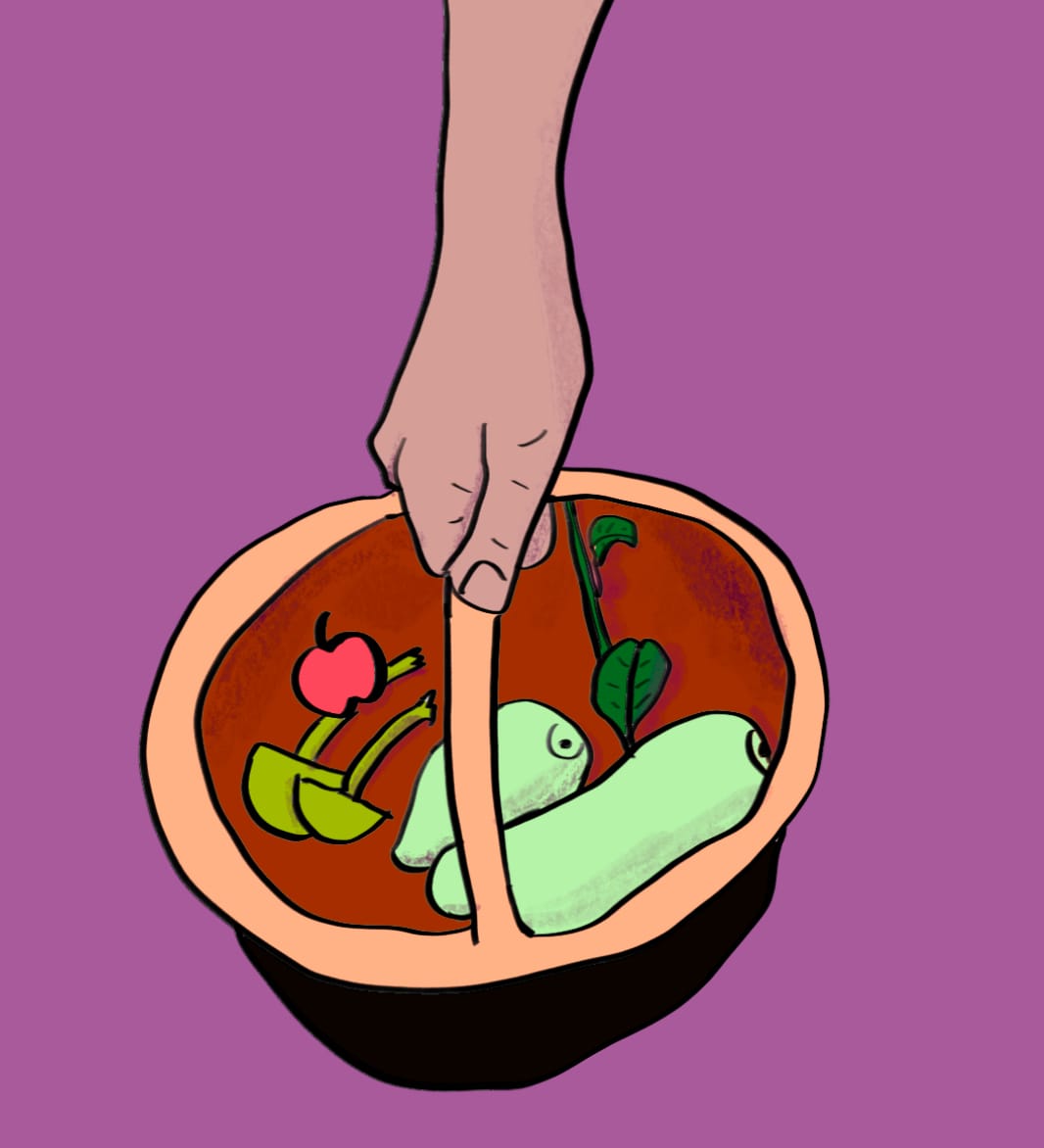
A painting of a person holding a basket of fruit and vegetables.
My friend Chris and I were accountability buddies in the Ness Labs Collector to Creator course a while back. This course was a really great introduction to collecting information and then doing something with it. Writing in particular, but whatever way you wanted to express yourself. Whatever way you wished to create.
In the course, we were presented with three archetypes of collector/creators. They were:
The Gardner - someone who collects seeds and combines them with soil and water to grow new ideas.
The Architect - someone who takes information and places it in logical structures to build new ideas.
The Librarian - someone who takes information and categorizes it for future reference when looking to build new ideas.
Note: these are from my recollection, not any notes I took, or quotes from the direct source. Which is kinda the whole point of this post.
In the course, they made sure to say these are archetypes and not definitions, and one can move about from one to the other, based on context.
I think of Chris as an Architect, and I think of myself mostly as a Gardener. But Gardener never quite fit correctly. Even with the above caveat.
More recently I texted Chris this:
This is a half baked thought, but I might want to bring a new type into the conversation. I think I’m more of a gardener but… I’m really a “forager”. I walk around, somewhat meandering, pick up something I see that’s interesting and throw into my bag. I meander some more, thinking about all the things in my current bag and if and how they relate. When I come to a pause, I write about what I’ve been thinking. That metaphorically describes my (inefficient?) process better, I think.
So, if I may be so bold, I’d like to introduce you to a fourth Archetype.
The Forager
I do wander based on my current and long term interests, intuition, and what I think is interesting at the moment. What I’m trying to make sense of.
I throw what I find in a bag. I have many. This goes against the best practice of “have a trusted system”. That typically means one, or a small set of tools. Whatever I’m carrying with me at the time is my trusted system. I switch note-taking apps, blog systems, pens, and notebooks all the time. I’m learning to be OK with that. Search on a digital device gets me most of what I’m trying to recall.
The rest, the stuff I forget? It’s in there somewhere and if it’s important it’ll resurface. Or not. I am not a completionist. Architects and Librarians maybe screaming at their screens right now. Sorry, friends.
Gardening and Foraging for leaders
Recently I had a great conversation with Robert Poynton. We talked about several topics, and leadership came up. Robert said good leaders are gardeners. They ”seed, feed, and weed”. I agreed, but brought up the concept of foraging in this context.
We agreed on that too. Good leaders also follow their interest, intuition, and the outcomes they’re working to achieve to see what is out there, which may be useful for them and their teams.
To conclude
I guess I just like to poke around, talk to people, and see what’s emerging. What is becoming.
Will tomorrow look and feel a lot like today? Probably, yes. Will five years from now look and feel a lot like today? Plausibly, maybe. Possibly, no one knows.
No one can see the future. Hell, no one knows exactly what to do right now. We strategize and plan and then the unexpected happens (it always does) right before we need to do that thing we spent all that time planning.
We’re taught to plan the work and work the plan. And arguably that’s important, but it can’t be urgent. It can’t be responsive and everything is unscripted anyway.
You know who has all this “embracing uncertainty” stuff figured out? 5 year old kids. They make up the rules of the game while they’re playing the game.
Play is such a powerful way to learn. To “learn the rules” sure, but also how to get along with people. How to communicate, collaborate, and create with one another.
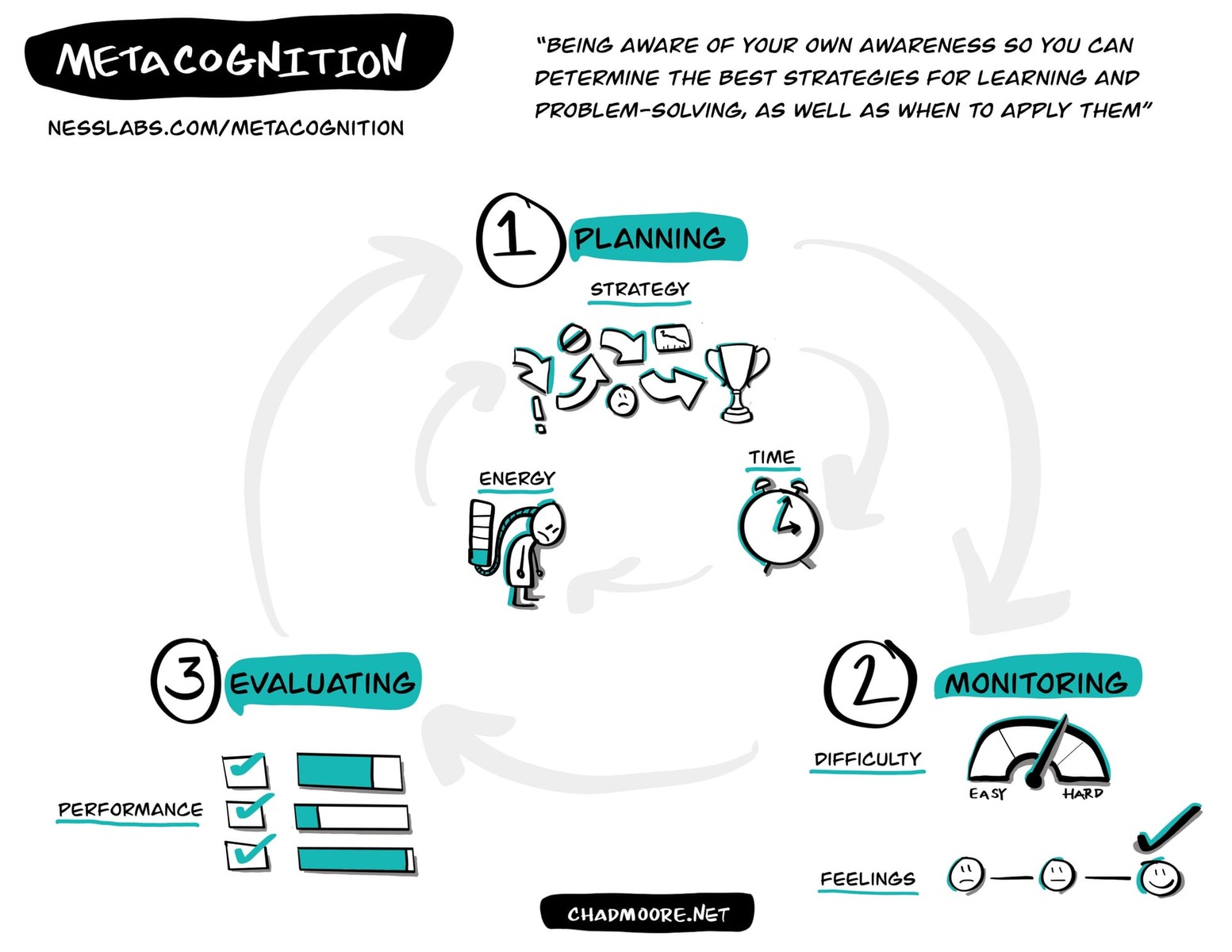
The systems were all a part of discourage play and encourage more serious ways of learning. Learning how to learn is important, and knowing which mindsets and tactics are best for the specific goal is great.
metacognition
However, we’ve lost play as a learning component along the way. We’ve lost a valuable tool in our help-me-make-sense-of-all-this toolbox.
You know who else has that “embracing uncertainty” thing figured out? Improvisers.
If you want to bring play back into your life (which has psychological benefits) reach out to an improv person or troupe near you.
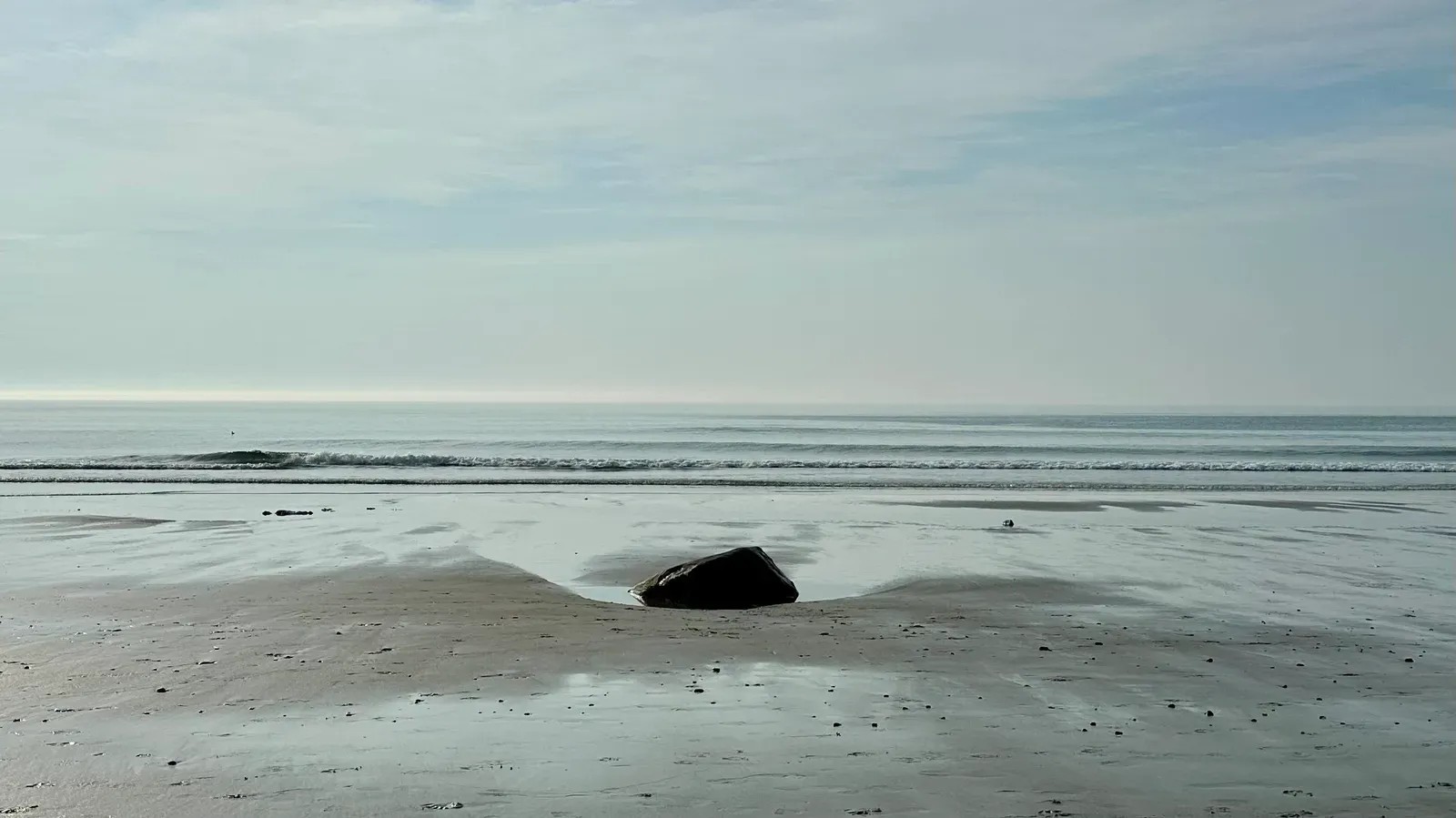
When I took this photo, the tide was low, but coming in. I’d say that this rock was a part of the land. When the tide is high, the rock would be covered by water. It would then be a part of the ocean.
The tide isn’t binary, it’s always changing based on the moon’s pull, low to high and back again.
Over a long time, the water erodes the stone. Bits of the stone get warn off and they become part of the ocean. And the sea bottom. And maybe marine life ingests parts of the stone. Maybe someday it’s completely changed into new things.
There isn’t stasis. Everything is changing, all the time. Liminal.
The Buddha taught that the source of human suffering and discontent is that we crave and cling to the things of this world under the mistaken view that they will last forever.
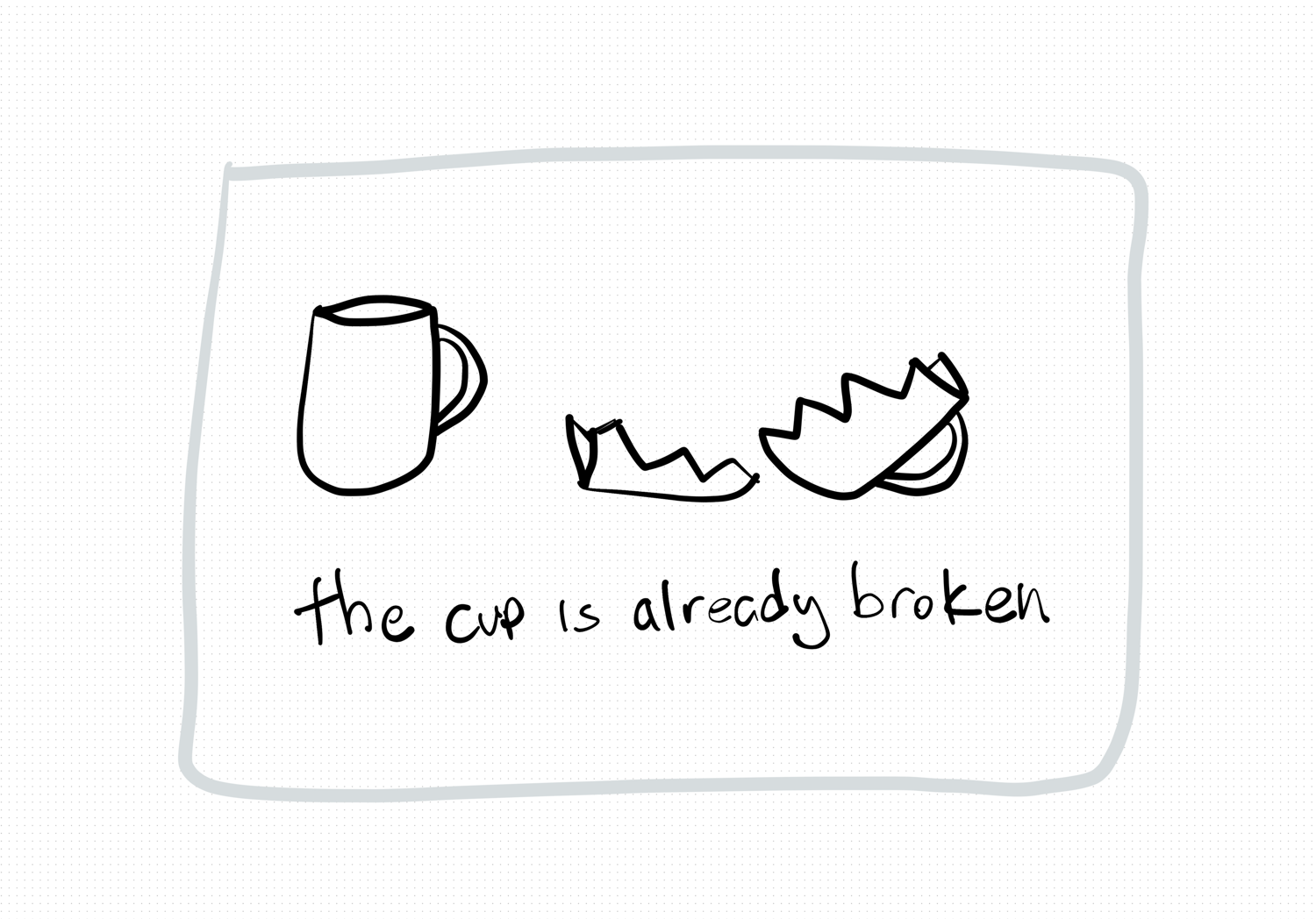
One day my teacher Ajahn Chah held up a beautiful tea cup, “To me this cup is already broken. Because I know its fate, I can enjoy it fully here and now. And when it’s gone, it’s gone.”
My mind and body will change significantly enough for me to not be here anymore. Changed into what? I have no idea. When? Not for a very long time, I hope.
You, me, a coffee cup, and that rock are all on different timelines. If we can focus on the present actions and distance ourselves from some future outcome, we might be at peace and be more present.
When I think about this, I feel connected to something larger and inspired to take action. To engage with my creativity and other people. To just be.
I talk a lot about purpose with my friend Chris. And I am often reminded of this banger of a quote from Alan Watts.
The meaning of life is just to be alive. It is so plain and so obvious and so simple. And yet, everybody rushes around in a great panic as if it were necessary to achieve something beyond themselves.
Every so often I am reminded about microsolidarity. Most recently by Marin Petrov in his beautiful article Riding the Crest.
Microsolidarity has been on my radar for a while, but I’ve never dug deep into it, until recently. Thank you, Marin.
It’s community building, in a nutshell, with these two goals:
The first objective of microsolidarity is to create structures for belonging.
The second objective is to support people into meaningful work. This is very broadly defined: you decide what is meaningful to you.
Who couldn’t use more belonging and a sense of meaning these days?
Upon deeper investigation, I am practicing Microsolidarity a bit already.
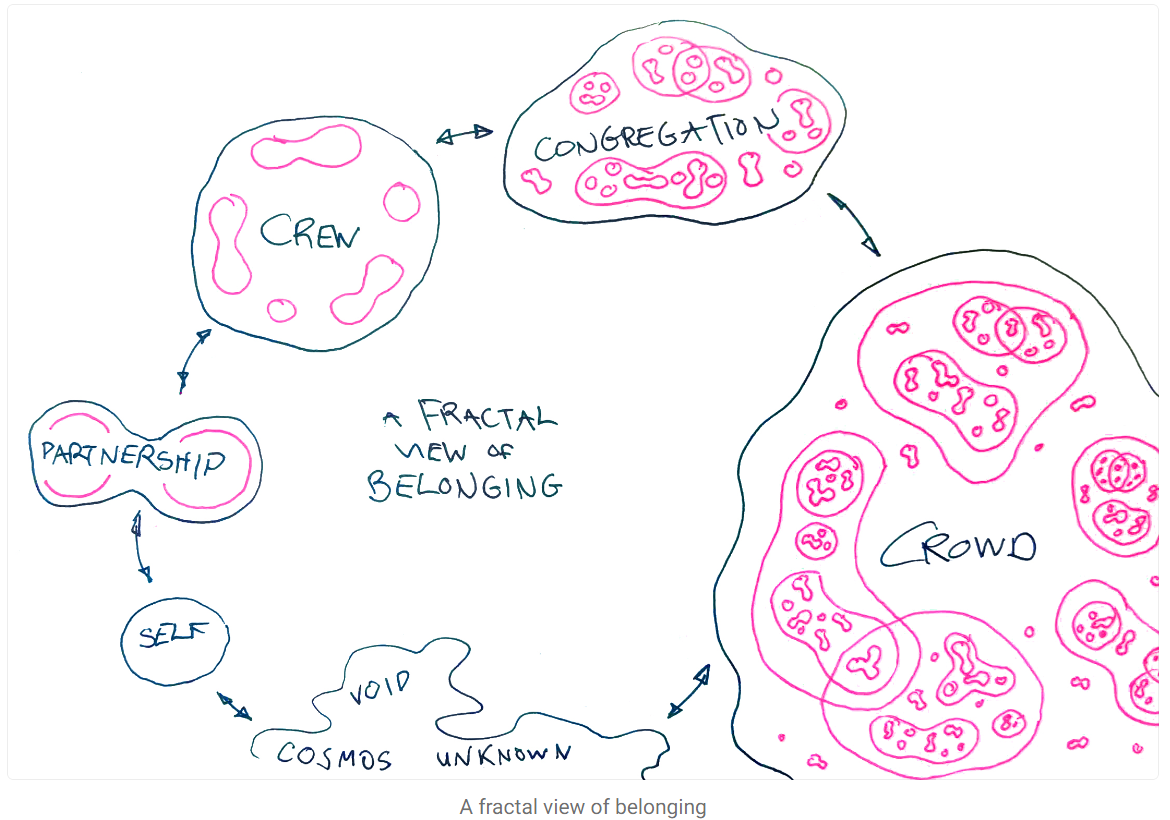
“The only theory you need to grasp is that different-sized groups are good for different things”.
The self (some framing around Internal Family Systems is apt here). This might warrant deeper thinking and writing.
Dyads (two people in a mutually respectful relationship). Aside from my spouse, I have a couple Dyads already.
C and I are partners in creativity, learning, sharing, and focus on “graceful accountability”.
B and I have known each other for 45 years, and support each other in numerous ways.
J and I only met a couple years ago, but we support each other in our comedy pursuits, thinking about what manhood means, and breaking out of the boxes we’re ‘supposed’ to be in based on societal expectations.
M and I support each other with our creative works, and all sorts of life things.
The Crew (4-6 people). Can act as a team to make things, and build projects together. Or just be there for each other.
M and I ran a Mastermind Failure club at the start of the pandemic. It was great for everyone until it wasn’t needed any longer.
Recently, I called a coaching circle together, and it’s been goin really well. N, S, and T are great, warm, open-hearted people who want to support each others growth. It’s early and we’re finding our feet a bit which is really exciting.
The Congregation (a crew of crews, 15-150 people).
I’m a member of a couple communities, but they aren’t connected really. They don’t come together. The pathway seems to be create some crews, then bring them together into a congregation. I’ve got a lot to learn before that.
The Network is the congregation of congregations, although there may be new developments around federations. I’ll see how that evolves as I do in my own practices.
I am following this path and looking to form another crew and/or join an existing congregation. I’ll have to think about that some more.
Are you practicing Microsolidarity now? Would you want to talk more about it?
This quote from the book The Untethered Soul: A Journey Beyond Yourself really struck me.
There is nothing more important to true growth than realizing that you are not the voice of the mind – you are the one who hears it. – Michael A. Singer
The Voice of the Mind aka the inner critic aka the monkey mind. It has many names.
The feeling of stepping aside from this voice is amazing to me. Letting it chatter and do what it wants while you listen or observe or ignore it.
This can be done with a meditation practice. One which incorporates the Dharma (spiritual teachings) of Buddhism, or one that focuses on a more secular nature.
But it can also be done anywhere. Try it now. Inside your head speak the word "trampoline". Stop reading and try it. Say it, sit with it for a minute and come back.
Trampoline.
You're back? Great. The voice in your head said that word, and you heard it.
Maybe the voice in your head spoke words or showed images, memories or other "mind movies" of things it associates with that word. You heard, watched, and observed that.
This is mindfulness, I think. Being aware that you are aware.
Long time listener, first time mindfulness-er
A couple years ago, when the now defunct racket (dot) com was a great and simple podcast tool, I recorded a couple podcast episodes. This is the first one I made, and I was reminded of it when thinking over the Vertical Breath again.
This represents one of the first times I ever experienced the realization that I was listening to the Voice of the Mind.
I can't figure out how to upload audio with the tool I am using to write this, so pardon it's absence.
Was today's experiment with the Trampoline one of the first times you realized you were listening to the Voice of the Mind? What do you think of the fact that you are not the Voice of your Mind?
I'm still working on this, especially when creating something or otherwise getting into "Flow". That state when you forget everything and are super focused.
I don't fully understand how or why the monkey mind is quieted by a creative act.
Today's Psychology, yesterdays ideas
Buddhists, Stoics, and others have been talking about mindfulness for thousands of years. Today's psychology is validating a lot of the old thinking.
From Positive Psychology (Positive Psychology is not toxic positivity, btw):
The prefrontal cortex is an area of the brain responsible for higher cognitive functions such as self-reflective consciousness, memory, temporal integration, and working memory. It’s an area that’s responsible for our conscious and explicit state of mind. However, in a state of flow, this area is believed to temporarily down-regulate in a process called transient hypofrontality. This temporary inactivation of the prefrontal area may trigger the feelings of distortion of time, loss of self-consciousness, and loss of inner critic. Moreover, the inhibition of the prefrontal lobe may enable the implicit mind to take over, allowing more brain areas to communicate freely and engage in a creative process (Dietrich, 2004). In other research, it’s been hypothesized that the flow state is related to the brain’s dopamine reward circuitry since curiosity is highly amplified during flow (Gruber, Gelman, & Ranganath, 2014).
I've heard this 'other part' of the brain referred to as the default mode network.
The default mode network (DMN) is a system of connected brain areas that show increased activity when a person is not focused on what is happening around them. The DMN is especially active, research shows, when one engages in introspective activities such as daydreaming, contemplating the past or the future, or thinking about the perspective of another person. Unfettered daydreaming can often lead to creativity. The default mode network is also active when a person is awake. However, in a resting state, when a person is not engaged in any demanding, externally oriented mental task, the mind shifts into “default.”
Fascinating. Does this resonate with you?
Thanks for reading, it's time to go think about trampolines.
Today I learned (or realized I already knew) that the monkey mind’s consistent chatter is neither wrong or right. It just is. Your awareness, your 'you' is the listener of the chatter. It observes and can make meaning from the nonsense, or ignore it.
This 10 minute video from Eva-Lotta Lamm is a tutorial on how to practice drawing. It's about the mental process not which pen, paper, or app to use.
I'd argue this mindset works for any creative endeavor.
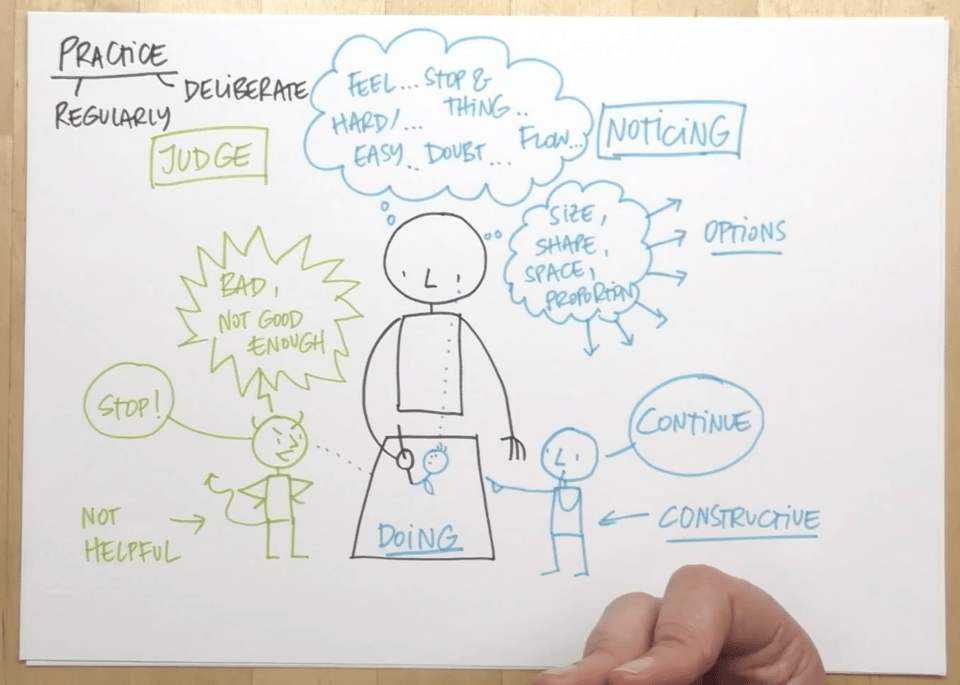
Here's a screencap of the video:
On the left is the Judge, aka the inner critic, aka the monkey mind. The monkey mind consistently makes value statements. They are conflicting, and informed by fear. It wants you to stop, so that you can't possibly get hurt.
On the right is the Awareness, the one who notices, and asks questions. It asks about options and wants you to keep going, so that you may grow.
The Highway
My therapist once told me that our minds are like the busiest and fastest highway ever. Thoughts fly by at a million miles an hour. They switch lanes without using their turn signals. They crash into each other, and somehow keep going at breakneck speeds.
The goal isn't to stop the cars. You can't stop your monkey mind from moving so fast.
The goal is to get out of the way of traffic. To grab a lawn chair and sit on the side of the highway and observe the traffic flying by.
How might we observe more and keep going versus reacting from fear and stopping ourselves?
Before you were you, you existed in some unknowable body of water. Some forces came together and caused a joining and you become you. And you propelled into existence.
You are a wave.
You crested and rush headlong into the unknown. You collect experiences as you head toward the finitude of the shore.
At some point, you crash or dissipate into that shore, and the you you know ends.
Those forces pull you apart, and back away from the shore. Back into that unknowable body of water.